Sunday, October 24, 2010

Team BAMFness Prototype Creation!

So for the upcoming Milestone of the TUI project, we had to make a low-fidelity prototype of our proposed project. Consuelo, Heidi, Annie and I got together during the week and plowed through the assignment. During our craft-making process, we learned a lot about the limitations of our design, and adjusted it accordingly.

Since Heidi and Annie are super artistic, they took charge of drawing out the storyboard and writing up a feasible scenario for the Chameleon Suit.
Heidi and Annie working hard on the paper designs of the suit.
Consuelo and I decided to tackle the actual construction of the suit.
We decided to use those rolls of multi-colored paper provided by Student Activities Office (since we didn't really go buy fabrics) along with some strings we found in the HCI lab. It turned out that the papers we used were super thin and easy to tear, which caused us SO MUCH trouble during the assembly of the suit. We based our suit on Consuelo's body size :) and I focused on making the top portion of the suit.
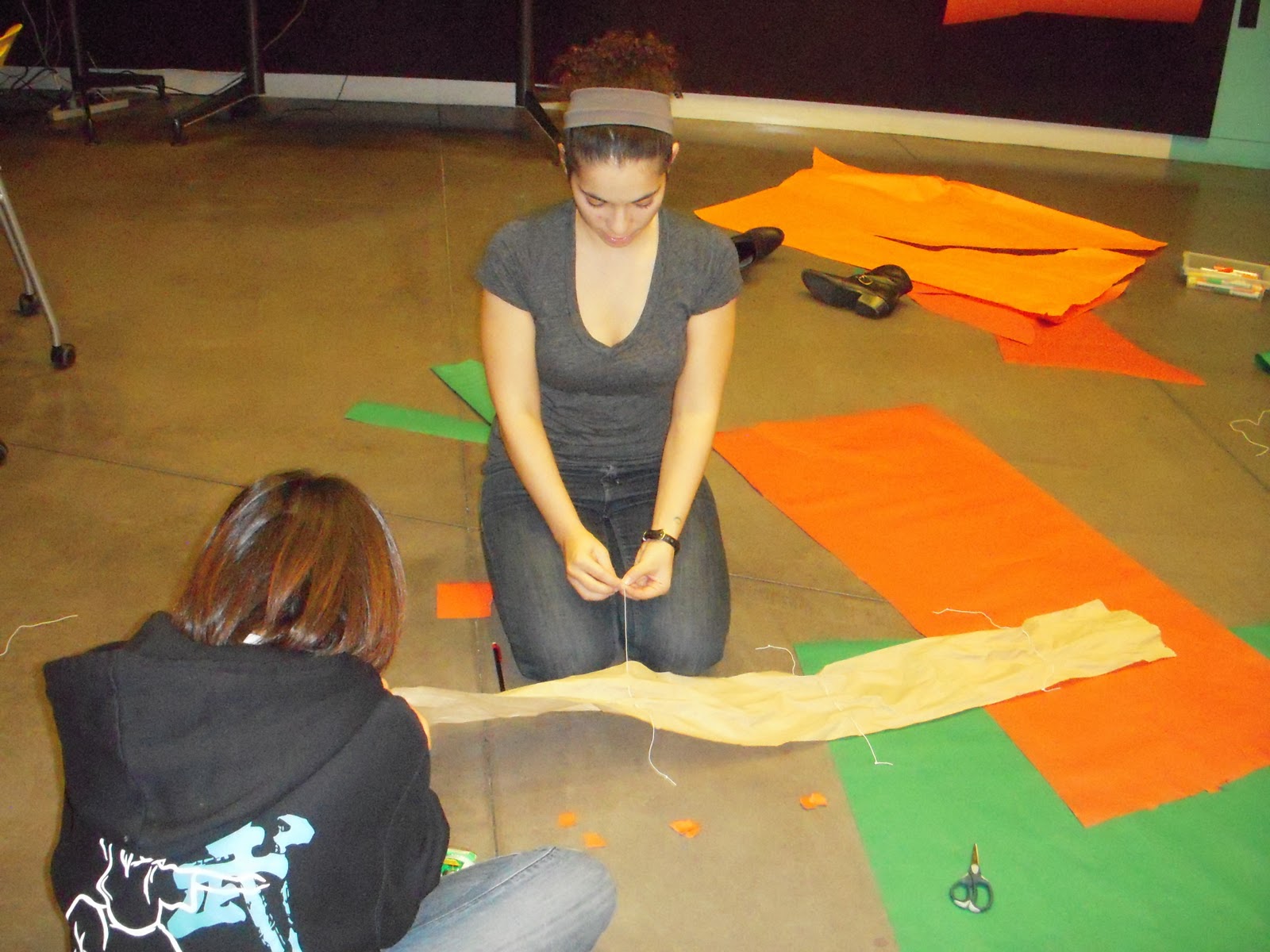
While measuring and cutting the paper, I realized just how difficult it was to actually make a piece of wearable clothing! There's so much details that need attention, such as shoulder width, arm length, how the shirt is going to fold/bend when the arm moves. So I told myself that before making a more expensive prototype, I'm going to research more into basic cloth designing concepts.
Soon after we started taping different papers together, Consuelo and I realized that because of the quality of the paper, it's almost impossible to fold/roll them up and expect the material to survive a second attempt. So instead of implementing the rolling/folding/bunching fabrics up technique we previously proposed, we adopted an alternative strategy (just for making this prototype) of making two different-sized sections of the limbs (arms and legs), and have the smaller section extend out of the larger section (kind of similar to how a biker would slide up their transparent visor, and the clear plastic would go over the actual helmet). This strategy ensure that the suit will still be wearable, and that it can actually survive our preliminary testing so we can showcase it in class the next day.
The pant trouser here is divided up into two sections. The section on the lower leg will slide up into the bigger section.
We also decided to only implement the arm extension, leg extension, and skirt roll-up features of the suit (because we haven't really thought about how to implement the collar-changing aspect of the design). Eventually with much swearing, tearing (not the crying kind, but the paper ripping kind), and taping, we managed to get the suit on Consuelo.

 Although the mechanisms on the suit are still very faulty, we thought this super-low fidelity prototype managed to deliver the basic idea of our project proposal.
Obviously we realized many shortcomings with the design of the suit (such as how to strategically place the extension mechanisms so they don't hinder/interfere with the wearer's movements, how to create a comfortable clothing template so the suit can actually be wore in real life without the wearer suffering from constant discomfort, and as well as the type of materials we will be using to make the suit, how sturdy they will have to be, etc).
Hopefully as we continue to modify our proposal, we will be able to come up with suitable solutions for these specific problems as well as think of other improvements we can apply to the suit.
Me having fun with the leftover googly eyes ^__^ (Okay, it's kind of creepy)

Heidi and Annie's cute drawings!

UIST '10 Afterthought

So I went to UIST '10 in New York City in the beginning of October. It was such an experience! Since it was my first time attending an academic conference (especially a computer science one), I had no idea what to expect from it. To tell the truth, I honestly thought people wore suits and dress pants at conferences, so that's pretty all I packed into my suitcase (which ended up with me wearing my oversized Wellesley sweater pretty much the entire time).
Aside from that little stump, I enjoyed my weekend there very much! There were so many interesting and unique projects presented from all around the world.

These are some of the presentations that I especially liked:
Hands-On Math: A page-based multi-touch and pen desktop for technical work and problem solving
I was very inspired by the different methods of data organization that this application used. The minimizing a portion of the paper by pinching/folding it is a very cool technique! It made me think about all the text that needed to be scrolled on the GnomeSurfer. If we can implement a similar technique, such as have portions of the gene sequence be minimized in the beginning, and allowing the option to expand them, that that would save users a lot of time and effort scrolling through the entire sequence. (And if we can come up with an awesome animation for the expansion/minimizing of information like they did in this project, then that'd be even cooler). 
Their idea of implementing a pannable workspace is also very applicable to the GnomeSurfer (we actually had a very similar idea about providing additional workspace to users). 

Another presentation that I really enjoyed was Chronicle: Capture, Exploration, and Playback of Document Workflow Histories. So basically this is a tool that records, annotates, and categorizes the different actions done on an image in an image processing software. It records brush strokes, layer creations, color adjustments, and any other type of interactions done on the image. Anyone using the program can just review the entire history process. They can even customize the playback so it'll focus on the actions of a specific tool or an unique area on the image. 
As a below-average occasional user of Photoshop, this is exactly the type of tools that I need! Every time I try to replicate certain effects from online tutorials, I can never really capture the exact methodology used. So having a program that can play back actions on the images is just awesome. 
Being able to review the process of object creation is such an important feature in most applications these days, it's almost an expected feature. 

One of the poster and demo presentations gave me a lot of ideas regarding our superhero costume project. Pinstripe: eyes-free continuous input anywhere on interactive clothing does exactly what it says. The presenters sew sensors into the textile of the garment, which then enables wearers to apply different types of input. The differences in pressure and target area can all be detected and differentiated, which allows so much more freedom in terms of integrating different types of interaction with the garment.The entire time that I was listening to their presentation, I thought to myself: instead of using touch sensors on our Chameleon Suit, which only allows binary inputs, why can't we implement something similar to this technology? Then when the wearer of the Chameleon Suit doesn't even have to wear multiple sensors because the pinstripes can detect all the necessary types of input. 

Overall I saw some amazing projects and ideas during this conference, and I definitely took away a lot of useful knowledge from it. It was a very fun weekend!


Monday, September 27, 2010

Analysis on Topobo

As defined by Van Dam, post-WIMP interfaces are interfaces "containing at least one interaction technique not dependent on classical 2D widgets such as menus and icons" [1]. I guess that makes Topobo a post-WIMP user interface. Topobo is a 3D constructive assembly system with kinetic memory developed by Tangible Media Group at the MIT Media Lab. As a modeling system, Topobo contains both physical inputs and outputs. It allows users to "directly manipulate objects rather than instructing the computer to do so by typing commands" [2], thus incorporating one of the post-WIMP interaction styles - Direct Manipulation. A user's ability to interact with Topobo is not hindered by any technical thresholds associated with programming physical models to move. Instead of writing up codes to make the Topobo blocks move, users can employ the pre-existing naive physics concepts to it. By drawing upon "some of humans' most basic knowledge about the behavior of the physical world" [2], users are able to manipulate the Topobo structures into recreating its previous movements. Instead of being limited by their abilities to express desired movements in programming languages, users can directly interact with the pieces themselves to generate the desired movements. 
However, there're certain tradeoffs in that comes along with implementing an interface that relies upon direct manipulation. The active blocks of Topobo embedded with kinetic energy only allows the duplication of movements physically created by the user. The designers at the Tangible Media Group made a tradeoff between reality and versatility. The range of motion of the Topobo piece and the speed at which it operates are solely dependent upon the physical input done by the user. If the user wishes to have one section of the model spin in a continuous fashion for a set amount of time, he or she would have to physically rotate that section of the model for the said time in order to reach the desired movements for the model. However, if the user was using a traditional GUI where all the movements were programmed into the Topobo blocks, then physically difficult to achieve movements such as continuous spinning or extremely fast rotation are easily accomplished with a simple line of code. The designers have favored a reliance on direct manipulation of the Topobo pieces applying naive physics. 

According to the definitions of TUIs stated by Kenneth P. Fishkin in his A Taxonomy for and Analysis of Tangible Interfaces, a "2D taxonomy is fruitful, one that uses as its dimensions embodiment and metaphor" [3]. So for Topbo, it can be categorized as a full embodiment user interface, where "the output device is the input device; the state of the device is fully embodied in the device" [3]. As an assembly system with kinetic memory, any changes/interactions done on the Topobo blocks are reenacted on the blocks themselves. If you rotate one section of the block by 30 degrees, the blocks will rotate the same section by the same degrees. Both the input and the output in this care are physical. 
In the Topobo assembly system, users manipulate and change the blocks on the structure, and their motions are recreated right back at them with the same blocks. This is a type of "Really direct Manipulation". There's no metaphor needed to describe the input and output process of using this TUI, and thus it can be categorized as a full metaphor. 

References:
1. Van Dam, A. Post-WIMP user interfaces. Commun. AC., 40 (2). 63-67.
2. Jacob, R., Girouard, A., Hirshfield, L., Horn, M., Shaer, O., Solovey, E., and Zigelbaum, J., Reality-Based Interaction: A Framework for Post-WIMP Interfaces. Proc. CHI '08, ACM     Press 2008. 
3. Fishkin, Kenneth. A Taxonomy for and Analysis of Tangible Interfaces. Pers Ubiquit Comput 2004. 8: 347-358. 

Superhero Proposal

Chameleon Suit


So for the TUI project, our group (Team BAMFness) decided to do a Chameleon Suit. 
We live in such a fast-paced world right now, and every second is extremely valuable. There's also an infinite amount of social rules and expectations that we have to follow/meet in our everyday lives, especially in the area of attires and appearances. So to waste even a couple of minutes changing outfits can no longer be seen as acceptable. 


The Chameleon Suit can address this problem. 
By using either a LED display or a projection system, we the team decided to have the suit change its appearances upon command/environment. 
~While on the way to an important business meeting, the unitard suit receives notification from the subject's mobile phone's calendar/synched schedule program about the upcoming meeting.It will project/display a corresponding pattern unto the suit to allow the subject to look presentable for the meeting on time. 
~At a party, sensors within the unitard suit detects high noise level (i.e. music), increased temperature due to people's body close together while dancing, and all other types of environmental cues. Upon receiving information from the sensor, the suit will alter itself to a fashionable party outfit. 
~By using a specific hand gesture/body posture, the subject can activate a color/pattern picking function on the suit. Placing the palm of his/her hand upon a specific color/pattern will allow the camera in the suit to pick up that design and transfer it onto the suit. BAM! Instant fashion statement!
~There can also be a specific number of pre-loaded outfits in the suit itself. By doing a swiping motion across the body while the sensor is activated, the subject can quickly change his/her outfit upon desire. 


This Bubelle Emotion Sensing dress developed by Philips Design gave us the idea that our Chameleon Suit can spontaneously alter its appearance based on different types of inputs. 

The Beat Dress is also very cool. A project created by the students of Malmo University in Sweden, the LED lights within the dress responds to the beats in music. 
There're just so many different possibilities that can be employed for the Chameleon Suit. We are also exploring a method to reproduce invisibility. So far we've came across similar effects done by people at the University of Tokyo, where they used ultra-reflective clothing coupled with a camera-projection system to trick the eyes into seeing "invisibility". 


Team BAMFness believes that the existing technology will enable us to successfully duplicate the proposed "superpower" of the Chameleon Suit. 
Tiny pico projectors such as the 7mm Explay Projetor Engine can be both discrete and powerful at the same time, and products similar to it can definitely be embedded into the suit. 


There're still a lot of technicality issues to be worked out, but hopefully Team BAMFness will be able to come up with a comprehensive draft plan for tackling this project soon! XD